Livia Carvalho
Designing the thinking behind the product.

Rebuilding design principles that actually get used

Company
Nike | Centauro
Year
2021
Type
Design culture · Facilitation · Leadership
Role
Senior Product Designer
Worked with
Content Product Designer Lead · UX & Marketing teams

Centauro had a design team of almost 30 people, with a set of design principles that almost nobody was using. The principles existed in documentation, had been created through a cross-functional workshop involving both UX and marketing, and were well-intentioned. But in practice, they weren't showing up in design decisions, critiques, or team conversations.

As the team was about to double in size, the risk was clear: without a shared foundation for how we make decisions, consistency would become impossible and alignment would depend entirely on individual judgment and informal communication.

Before proposing anything new, I wanted to understand why the existing principles weren't being used. Rather than assuming, I ran a structured workshop with the entire design team to find out.

The problem wasn't that people didn't care about principles. It was that the principles didn't give people anything to hold onto. They were too broad, too many, and too abstract to apply in a real design decision.

Three root causes emerged from the workshop: the principles weren't memorable: designers had to look them up to recall them. They weren't applicable: it wasn't clear how to connect them to daily decisions. And they were too broad in scope: they tried to say everything and ended up directing nothing.

With the team about to grow, we decided this was the right moment to start from scratch rather than patch what wasn't working.

I designed a multi-stage workshop process that took the team from diagnosis to ownership. The goal wasn't just to produce better principles. It was to produce principles the team had genuinely built together, because participation was the only way to get real adoption.

The process had six stages: understanding what principles are and what makes them effective; each person creating three candidate principles; grouping by similarity; small groups defining and writing three principles each; a presentation and vote to select the final set; and finally, applying the chosen principles to real pages of the Centauro website to test whether they actually worked in practice.

That last step revealed something important: what the team had produced weren't quite principles yet. They were three broader concepts (trust, simplicity, empathy) with a cluster of values and ideas underneath each one. Rather than forcing them into a principle format, I adapted the process to work with what had actually emerged.

We added a refinement stage: writing and rewriting short sentences that captured each concept, testing different wordings against each other, discussing what different people understood when they read the same sentence. Language turned out to be the hardest part of the work.

We also added something we called "What does that mean?" A practical complement to each principle with concrete examples of how it should show up in daily design decisions. This was contributed to asynchronously by the whole team, which served as both a participation exercise and a comprehension test: if someone's contribution was very far from the intended meaning, we knew we needed to rewrite.

The final output was three design principles, each with a short memorable statement and a set of concrete "what this means" examples written by the team:

Confidence decides the game
Everything we do must generate trust, whether in a shopping journey or the practice of a sport.
We sweat our shirt for simplicity
Simple solutions take work and require a lot of training, but they will take our game to the next level.
Cool head, warm heart
Emotions inspire us to build the best solution, but we always make decisions rationally.

The principles were then embedded into Figma templates, team pages, and critique documentation, bringing them into the places where design decisions actually happen, rather than left in a document that nobody opens.

Workshop — Miro dashboard during the principles creation process

The principles became part of the team's critique culture and design documentation. The adoption wasn't instant. It never is. But the foundation was different: these were principles the team had built, tested, and written themselves. The sense of ownership changed how people related to them.

The process itself also became a model for how to approach team alignment problems: start with diagnosis, involve everyone, make the abstract concrete, and embed the output into daily routines rather than documentation.

Want to know more?

Reframing how member acquisition works

Company
eDreams ODIGEO
Year
2024 — 2025
Type
Strategy · Concept · Execution
Role
Principal Product Designer
Worked with
Product leads · C-level stakeholders · Engineering · Cross-vertical teams

Prime is eDreams' subscription program, one of the most important revenue drivers in the business. Acquiring new Prime members is a key goal, and the mobile funnel is where most of that happens.

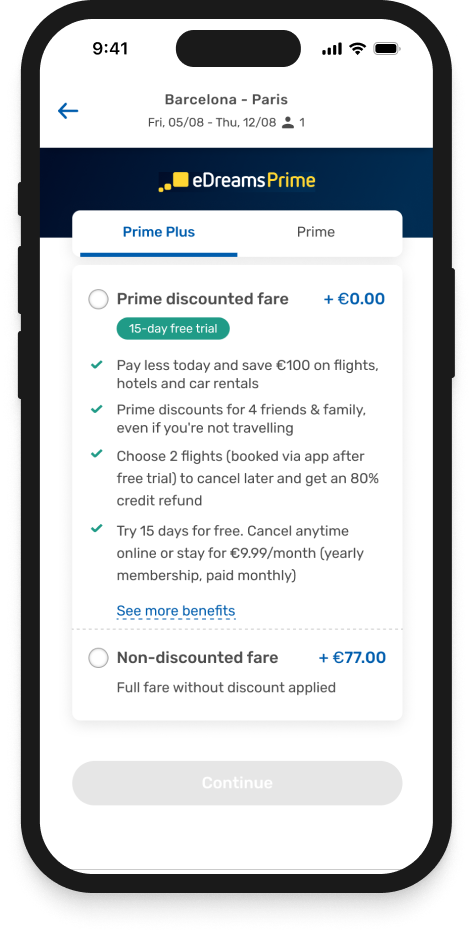
At the time, the existing experience had serious usability issues. Through Fullstory analysis, I identified patterns of back-and-forth navigation, click rage, and high drop-off on the Prime page, signals that users weren't understanding the value proposition, or weren't encountering it at the right moment.

Current state — Prime funnel analysis

The team's initial instinct was to improve the existing Prime page: better layout, clearer copy, stronger visuals. A reasonable direction, but one that accepted the current mental model without questioning it.

The real problem wasn't how we were showing Prime. It was where and when we were asking people to commit to something they didn't yet understand.

After running a benchmark across competitors and analysing behavioural data, I reframed the opportunity: instead of asking users to navigate to a separate page and make a deliberate decision, what if Prime was introduced more naturally, at the moment of checkout, in a way that felt low-friction and transparent?

This shift changed the entire design direction. The goal was no longer to improve the Prime page. It was to rethink how Prime acquisition happened in the funnel.

Before proposing anything, I ran a thorough audit: Fullstory sessions, funnel metrics, Prime page performance, and a competitive benchmark. I was looking for patterns, not just problems.

What I found was that users weren't rejecting Prime. They were confused by it. The value wasn't landing at the right moment, and the commitment felt too large too early.

Rather than benchmarking travel competitors, who were all making similar mistakes, and looked at a completely different sector: food delivery. Uber One had solved a similar problem elegantly: a simple checkbox at checkout surfacing an instant, contextual saving. No separate page. No forced decision. Just a transparent offer at the right moment.

That cross-industry leap was the unlock. It showed that the solution didn't need to live within the conventions of travel booking. It needed to borrow from somewhere that had already figured out low-friction subscription acquisition.

Benchmark — Uber One checkout checkbox
Benchmark — food delivery membership patterns

Prime is a high-stakes touchpoint. The solution had to work across a complex matrix of user states. Getting it wrong for any of them would mean either missing an acquisition opportunity or creating a frustrating, confusing experience.

I mapped and designed for every relevant scenario: existing Prime members, users who had already used their free trial, users who were logged in vs not, users with price freedom vs without. Each state required a different approach: different messaging, different hierarchy, different CTA logic.

Scenario mapping — user states and corresponding experiences

This was the hardest part of the work: not the concept itself, but making sure the concept held up across every edge case without becoming inconsistent or manipulative.

Because Prime acquisition is one of the most sensitive areas of the business, this proposal required buy-in at every level: product leads, design leadership, and C-level stakeholders. I presented multiple times, always grounding the direction in behavioural data and the benchmark rather than design preference.

The proposal was approved at every level and moved into A/B testing.

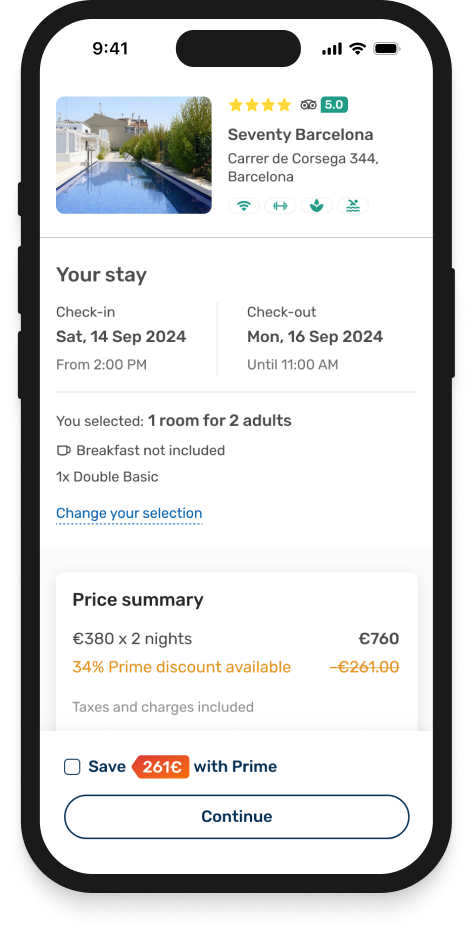
Final design — checkout page with Prime checkbox + benefits drawer

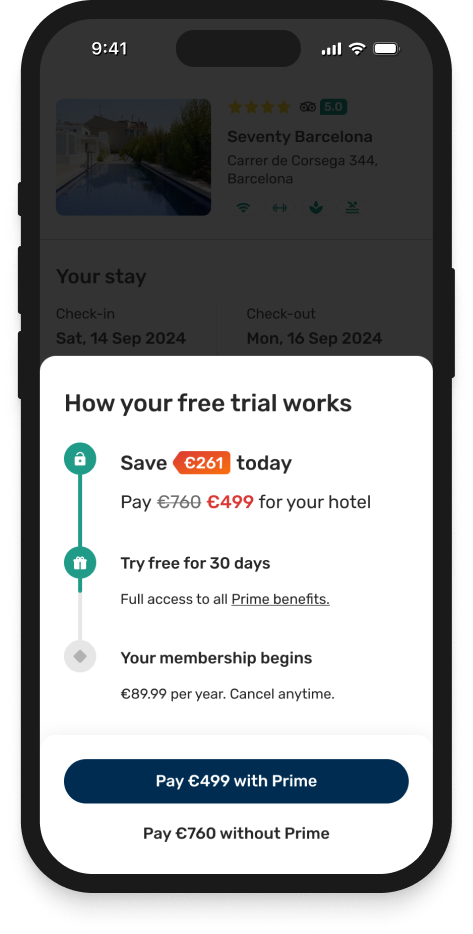
The final solution introduced two connected components: a persistent checkbox in the sticky checkout footer, and an expandable drawer surfacing Prime benefits in a timeline format: clear, honest, and non-intrusive.

I also proposed combining the guest and payment pages into a single checkout page, reducing friction and contributing to higher continuance through the funnel.

Final UI — checkout integration
Benefits drawer — closed state
Benefits drawer — expanded state

One of the things I valued most about this project was its impact beyond its own scope. Other teams and verticals started referencing or adapting parts of the solution.

The project completed A/B testing and delivered measurable results across both acquisition and engagement metrics. But the most lasting impact went beyond the numbers.

+12.49%
Prime First — uplift in new subscribers acquired through the funnel
+3.17%
Issued/Visits for Exclusive — improvement in Prime conversion rate
Finalist
eDO Innovation Awards — recognised as one of the most innovative initiatives of the year

After the proposal was shared, other teams started testing variations of it, adapting the checkbox mechanic, the drawer structure, or the acquisition logic to their own products and moments in the funnel.

This kind of cross-team influence is hard to measure but easy to recognise. It happens when the thinking behind a solution is clear enough that others can pick it up, adapt it, and run with it independently. The proposal didn't just solve one problem. It changed how other teams thought about a whole category of problems.

Next case study

Building a modular system for ancillary products

Company
eDreams ODIGEO
Year
2025 — 2026
Type
Framework · Systems · Strategy
Role
Principal Product Designer
Worked with
Product Management · Design team · Data & Personalisation

eDreams offers a wide range of ancillary products throughout the booking journey: insurance, seat selection, bags, cars, and more. Each product had its own way of being displayed, often designed in isolation, without a shared structure or logic.

Every time a new product was added or an existing one changed, the team was essentially starting from scratch, reinventing the layout, the hierarchy, the interaction. The result was a funnel full of disconnected, inconsistent experiences that were hard to maintain and harder to scale.

Audit — current state of ancillary displays across the funnel

The initial framing of the problem was visual: the displays looked different, had inconsistent sizes, and used different patterns. The natural instinct was to standardise the look and feel.

But visual inconsistency was a symptom, not the cause. The real problem was that we had no shared understanding of what each display was trying to achieve, for the user, for the design, or for the business.

I reframed the challenge: instead of asking "how should these look?", I asked "what intent are we serving?" That shift opened up a completely different solution space, one based on purpose rather than appearance.

Once the question changed, the answer became much clearer: a modular system driven by shared intent across user needs, design goals, and business objectives.

Before defining any solution, I needed to understand the full scope of the problem. I audited how every ancillary product was currently displayed across the funnel, identifying inconsistencies, redundancies, and missed opportunities.

I then mapped all products by their typology, composition, needs, and value proposition. This was the hardest part of the work: finding a solution flexible enough to cover the most relevant scenarios without becoming so complex it would be impossible to maintain or too inconsistent for users to follow.

Product mapping — typology, needs, and value proposition

After exploring several approaches, I landed on three variants, each defined not by how they look, but by the intent they serve:

Deep Dive
For complex or high-value products where the user needs to understand, compare, and decide. Maximum focus and explanation.
Spotlight
For strategic products that need context but not full attention. Balances visibility with simplicity.
Teaser
For briefly introducing products the user isn't actively looking for. Creates awareness without cognitive overload.

Each variant has defined UI weight, core elements, and optional elements, giving teams enough structure to be consistent, and enough flexibility to adapt to different products and moments.

Deep Dive — visual concept
Spotlight — visual concept
Teaser — visual concept

One of the most important design decisions was making sure the system wasn't just a visual framework. I connected it to propensity models and user personas, so the right variant could be selected not just based on product type, but based on who the user is and how likely they are to engage.

This created the foundation for a personalised but familiar experience: users encounter different products in different ways, but the underlying logic feels consistent and coherent.

The final system defines three modular variants that any ancillary product can adapt to. Each product doesn't need to look identical across variants, but it must share the same intent.

I translated the concept into visual proposals, defined display and visibility rules, and created documentation to align the team and enable future teams to apply the system independently.

Full system — three variants applied across products
Display rules documentation
Persona and propensity integration

The system is currently being tested. Results are not yet available, but the goals are clear, and the value of the framework is already felt in how the team approaches new products.

Reduce inconsistencies across the ancillary experience in the booking funnel
Improve development speed by providing a reusable, documented structure
Enable personalisation at scale through integration with propensity models and personas
Next case study

Reducing drop-offs when prices change at checkout

Company
eDreams ODIGEO
Year
2024
Type
Behavioral design · Contextual logic
Role
Product Designer
Worked with
Data team · PM · Engineering

Repricing happens when a hotel raises the price of a room between the moment a user selects it and the moment they reach checkout. It's a common and unavoidable part of the travel booking experience, but how it's communicated makes all the difference.

At eDreams, 4.8% of users in the Hotels funnel went through a repricing. The data was clear: the larger the price increase, the higher the drop-off. Users experiencing a repricing of more than 30% converted 18.2% less than those who didn't encounter one at all. Beyond conversion, repricing also risked pushing users to competitors and damaging long-term trust.

Data — conversion impact by repricing percentage

The existing experience showed no repricing communication at all. Users would simply arrive at the payment page and find a different price than expected. There was no explanation, no context, no choice. Just a surprise at the worst possible moment.

The problem wasn't the repricing itself. It was that users felt deceived. The solution wasn't to hide the price change. It was to communicate it in a way that felt honest, contextual, and empowering rather than manipulative.

Before proposing any direction, I built a structured discovery document mapping what was known, what was unknown, and what was assumed. Working alongside the data team, I investigated three key questions: how many users drop off immediately after seeing a reprice? At what percentage increase do users abandon? And how much revenue is lost from reprice drop-offs compared to absorbing the cost?

The answers shaped every design decision that followed.

The data revealed that not all repricings are equal. A 0–5% increase, the most common scenario, had a much lower drop-off rate than larger ones. eDreams could absorb changes up to 2.3%, which covered a significant portion of cases. The real damage happened at higher percentages, especially for users booking further in advance, for longer stays, with higher booking values, or for groups.

This meant a single, one-size-fits-all repricing message was the wrong approach. The communication needed to adapt to the situation.

I designed a contextual communication system with distinct responses depending on the repricing scenario:

Absorbed
Small increases (≤2.3%) are absorbed by eDreams — users continue normally with no disruption
Informed
Larger increases trigger a modal or drawer showing the new price, a price trend chart, and a clear choice to continue or go back
Sold out
When rooms are unavailable, a "sold out" message replaces the repricing modal — reducing the perceived price manipulation

A key decision was where to surface the repricing message. After analysis, the guest page, not the payment page, proved to be the better moment: users hadn't yet committed their payment details, so the interruption felt less jarring and conversion held up better.

On desktop, the repricing appeared as a modal. On mobile, a drawer. Both included a price trend chart to contextualise the change, showing that price fluctuation is normal, and a "Go back to hotel's page" CTA, giving users real agency rather than a dead end.

Modal — desktop repricing message
Drawer — mobile repricing message
Decision flow — repricing logic across scenarios

The final solution covered three distinct scenarios: sold out, higher-value repricing (shown at the hotel details page), and lower-value repricing (shown at the payment page), each with its own communication logic, tone, and set of actions.

The design prioritised honesty and user control: showing the exact new price, explaining why it changed, giving users a clear choice, and never trapping them in a dead end. The price trend chart was a particularly considered detail: it reframed the repricing as a market reality rather than a platform problem.

Sold out scenario
Higher-value repricing modal
Lower-value repricing — payment page variant

Results were measured approximately July 2024, after the MVP rollout.

~50%
Decrease in repricing drop-offs — users who encountered a repricing were significantly more likely to continue
↑ CVR
Improved overall conversion in the Hotels funnel for users who went through a repricing event
Guest page
Showing the modal at the guest page — not payment page — delivered better conversion, validating the placement decision
Next case study

Designing a hotel page that adapts to context

Company
eDreams ODIGEO
Year
2024
Type
Vision · Experience strategy · Concept
Role
Principal Product Designer
Worked with
PM · Engineering · UX Research

The Hotel Details Page is one of the most critical moments in the booking funnel. It's where users decide. But the existing page had grown organically, accumulating information and features without a coherent structure or a clear point of view on what it was trying to achieve.

Almost all hotel details pages in the industry look the same: the same sections, the same order, the same amount of information regardless of who's looking or what they need. A solo traveller booking for tomorrow night sees the same page as a family of four planning a week-long trip. That sameness was the real problem.

Current state — Hotel Details Page

I started with research: user testing sessions, past usability data, and competitive benchmarking, to understand what was actually happening on the page. The findings confirmed what the data suggested: the page wasn't failing because of any single broken element. It was failing because it couldn't adapt.

The central question I kept returning to was: how can we anticipate what the experience is going to be like for the user, before they even arrive at the hotel? That became the design brief.

If we know a user is searching for a stay for four people, two of whom are children, we should be surfacing child-friendly amenities prominently. If we know from past behaviour that they consistently stay in hotels with exceptional breakfast reviews, that should be highlighted. The page shouldn't just display information. It should prioritise the right information for the right person at the right moment.

Before any visual work, I ran a usability study with 15 participants to evaluate the existing page. Users generally found it informative and structured, but identified real friction points: Prime membership benefits were unclear, promotional discounts overshadowed key information, and pricing wasn't always legible. Was that per person or for the whole stay?

These weren't cosmetic issues. They were hierarchy problems. The page was saying too many things at the same volume.

Once I had a clear picture of the problems, I built an information model before touching any designs. The goal was to map every element that could appear on the page: room name, refund type, boarding type, price, availability, amenities, descriptions, and classify each one by type, relevance to the user, requirement (mandatory vs conditional), goal (functional vs marketing), and state (static vs dynamic).

This was essential because hotel data is messy: some hotels have certain information, others don't. Some details are always relevant, others only matter in specific contexts. The model gave me a shared language for making decisions about what to show, when, and why.

Information modelling — mapping all elements by type, relevance, requirement, goal, and state

The proposal wasn't a redesign from zero to one. That would have been too risky and too slow. Instead, I designed a full future vision and then broke it into a modular delivery sequence that could be tested and shipped incrementally:

Step 1
Spacing, colour, sizing, typography — foundational improvements that don't require structural changes
Step 2
Gallery redesign — stronger visual impact, better room presentation
Step 3+
Section by section — room information, reviews, map, Prime entry points, each shipped and validated independently
Proposal — full vision for the Hotel Details Page

The final vision was a page that could adapt to the user rather than presenting the same experience to everyone. The same structure, but with content prioritised differently depending on who was looking: their search context, their booking history, their group composition.

A family of four with young children would see family-friendly amenities surfaced prominently. A user who consistently books hotels with high breakfast ratings would see that highlighted. The page would feel familiar. The structure doesn't change enough to disorient, but it works harder for each individual.

I also tested the final vision with 15 users. The response was positive: clear structure, easy to scan, well-received visual design. Key areas of confusion: Prime pricing, discount hierarchy, price per person vs total, were directly addressed in the new design.

Room information — restructured for clarity
Reviews widget with contextual smart pills
Gallery redesign
Prime login entry point

Because the work was delivered modularly, there is no single consolidated metric for the full vision. Individual modules have shipped with measurable results. The full revamp continues to be implemented incrementally.

+6.63%
CVR uplift from map improvements — one of the first modules rolled out from the vision
+6.18%
LTV improvement from the same map module
15 users
Usability study confirmed strong clarity, scannability, and visual quality in the final vision
Next case study
email copied to clipboard

Rebuilding a financial app inside a different one

Company
PicPay
Year
2022
Type
Product integration · Open Finance · Strategy
Role
Principal Product Designer
Worked with
3 designers · Engineering · PM · Data

In July 2021, PicPay acquired GuiaBolso, one of Brazil's most well-known personal finance apps. GuiaBolso had over 6 million users and had been offering personalised financial management tools based on shared data even before Open Banking formally existed in Brazil.

I joined at the beginning of the integration process. There was no brief, no plan, no playbook. Just a newly acquired product, a team to lead, and the question: how do you take a full financial management app and bring it inside a completely different one, without losing what made it valuable?

GuiaBolso and PicPay — two products, two very different audiences

The obvious challenge was technical: different brand, different structure, different logic. But the harder problem was the audience.

GuiaBolso users had actively chosen to manage their finances. PicPay users were a completely different population: millions of people who had a bank account but had never tracked an expense in their life. We weren't just migrating a product. We were introducing a concept to people who had never asked for it.

On top of that, Open Finance was brand new in Brazil. Getting users to connect their bank accounts from other institutions required building trust around something most people didn't understand yet. And every fintech in the country was racing to be first: whoever got users to link their accounts first would almost certainly keep them.

The whole company was watching. This product was PicPay's vehicle for winning the Open Finance race.

I led a team of three designers, working alongside researchers, content people, and a manager, across a product that touched every financial dimension of a user's life: payments, receipts, credit card bills, bank statements, and cross-bank account aggregation.

We started by questioning everything GuiaBolso had built. Some of it was right for GuiaBolso's users but wrong for PicPay's. The category system, for example, had grown bloated over time. We had to simplify it significantly without losing the granularity that made it useful. Every decision required holding two very different users in mind at the same time.

The consent flow for Open Finance was one of the most critical pieces of work. Users needed to understand what they were agreeing to, feel confident that their data was safe, and see immediate value in connecting their accounts. We had to design not just a flow, but the trust around it.

Tone of voice was another challenge that's easy to underestimate. GuiaBolso spoke to financially aware users. PicPay's audience was much broader. Everything, from error messages to empty states to onboarding copy, had to be rethought.

Information architecture — rebuilding the category and account structure
Open Finance consent flow
Multi-account overview

The vision we were designing toward was PicPay as the "Conta das Contas", an account of accounts, where users could see and manage all their financial relationships in one place, regardless of which banks they used. That was the north star.

The MVP alone was substantial. Financial management is not a simple product. Getting to something that was clear enough for a first-time user, complete enough for someone who had used GuiaBolso for years, and trustworthy enough for Open Finance to work, required sustained design thinking at every layer of the experience.

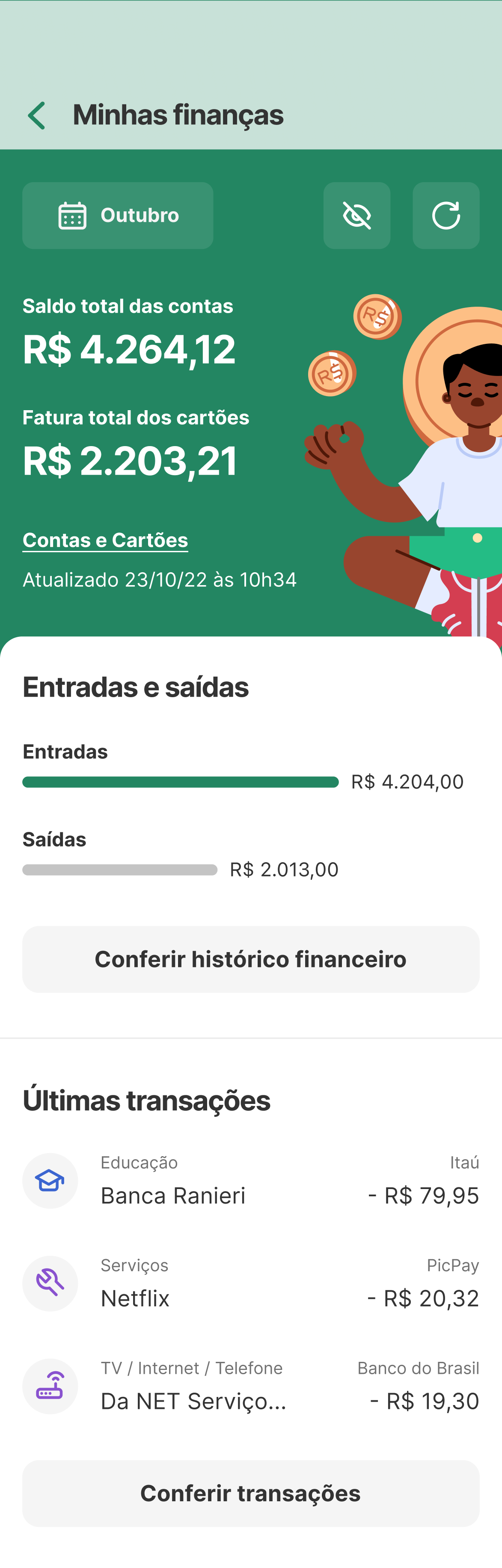
Minhas Finanças — final product vision
Spending categories
Cross-bank statement view

I left the company before the product launched. The foundation my team and I built carried through to the final release in October 2022, when "Minhas Finanças" went live for all PicPay users.

1M+
Open Finance consents at launch, with an 80%+ consent rate, well above the market average in Brazil at the time
6M+
GuiaBolso users migrated into PicPay by November 2022, when GuiaBolso was officially shut down
Conta das Contas
PicPay established as the central financial hub, positioning it ahead in Brazil's Open Finance race
Next case study

Long before I became a Product Designer, I was finding ways to understand how things work — photography, illustration, 3D modeling, fashion, automotive design, poetry, tattooing. The medium kept changing. The curiosity didn't.

That same curiosity is what I bring to product design. I'm most useful when a problem isn't well-defined yet — when the temptation is to jump straight to solutions and someone needs to slow that moment down. I've found that the most valuable thing a designer can do at senior level isn't to have the best ideas, but to ask the right questions early enough that the team doesn't spend months solving the wrong thing.

Beyond the work itself, I care about building the conditions for good design to happen — shared language, stronger thinking, the kind of environment where a team can do their best work without reinventing everything from scratch.

I care about craft. I care more about whether the thinking behind the work is sound.

Outside of work, you'll probably find me reading, baking, drawing, or going for a walk.

Experience
2022 — now
eDreams ODIGEO
Travel e-commerce
Principal Product Designer
Shaping the ancillaries experience by defining vision, design principles, and scalable frameworks. Supporting and mentoring a team of 15 designers. Contributing to AI initiatives by developing skills and agents tailored to design workflows.
2021 — 2022
PicPay
Fintech
Principal Product Designer
Led the personal financial management product, overseeing its entire lifecycle from product strategy to final execution. Managed a team of three designers, facilitating design workshops and critique sessions.
2020 — 2021
Nike | Centauro
Sports e-commerce
Senior Product Designer
Improved the user experience of mobile and web products. Conducted workshops and contributed to the evolution of the company's product design process.
2019 — 2020
Creditas
Fintech
Senior Product Designer
Enhanced the user experience and interface design of a secured insurance car loan product across each phase of the design process.
2016 — 2019
Colab
Government · Social network
Product Designer
Managed both B2C and B2B solutions from product strategy to final execution. Led initiatives related to brand identity establishment and maintenance.
2015 — 2016
Editora Globo
Editorial
Product Designer
Enhanced user interfaces of applications and websites. Contributed to online and offline marketing materials for magazine publications.
Outside the screen
Photography
Illustration
3D
Drawing
Fashion
Tattoo
Automotive
Photography